$3.79 billion in a single day, a crashed internet, and… a 5.7/10 rating from players. What does the release of GTA VI mean for Take-Two’s stock
Thirteen years and two months of waiting have come to an end, and stock market speculation has given way to the first concrete figures. If anyone had any doubts about whether Grand Theft Auto VI could live up to the hype—the biggest in pop culture history—the answer came instantly—and with such force that the network…

Thirteen years and two months of waiting have come to an end, and stock market speculation has given way to the first concrete figures. If anyone had any doubts about whether Grand Theft Auto VI could live up to the hype—the biggest in pop culture history—the answer came instantly—and with such force that the network infrastructure in the United States buckled under the strain. Comcast and Charter, the two largest U.S. internet service providers, are reporting record-breaking traffic levels. At its peak, nearly a quarter of all traffic on the Comcast network was generated solely by downloads and launches of the new Rockstar Games title. From the perspective of Wall Street investors, however, the most important question is a different one: Will this record—which far exceeded analysts’ forecasts—be enough to push Take-Two Interactive (TTWO) shares to new all-time highs, despite the surprisingly lukewarm reception the game has received from some gamers themselves?
A record that shattered expectations (and the board’s conservatism)
According to Take-Two’s estimates, GTA VI generated $3.79 billion in retail revenue from pre-orders and on launch day (November 19, 2026), selling as many as 32.5 million copies even before the servers officially went live. That’s a result from another galaxy. Adjusted for inflation, the new installment earned 3.2 times more than GTA V in its first 24 hours and more than tripled the box office opening weekend of Avengers: Endgame ($1.22 billion). What’s more, the official figures easily surpassed both Sensor Tower’s earlier estimates for digital sales ($2.36 billion) and the very ambitious projections from the brokerage firm Wedbush ($3.0 billion by the end of the year).
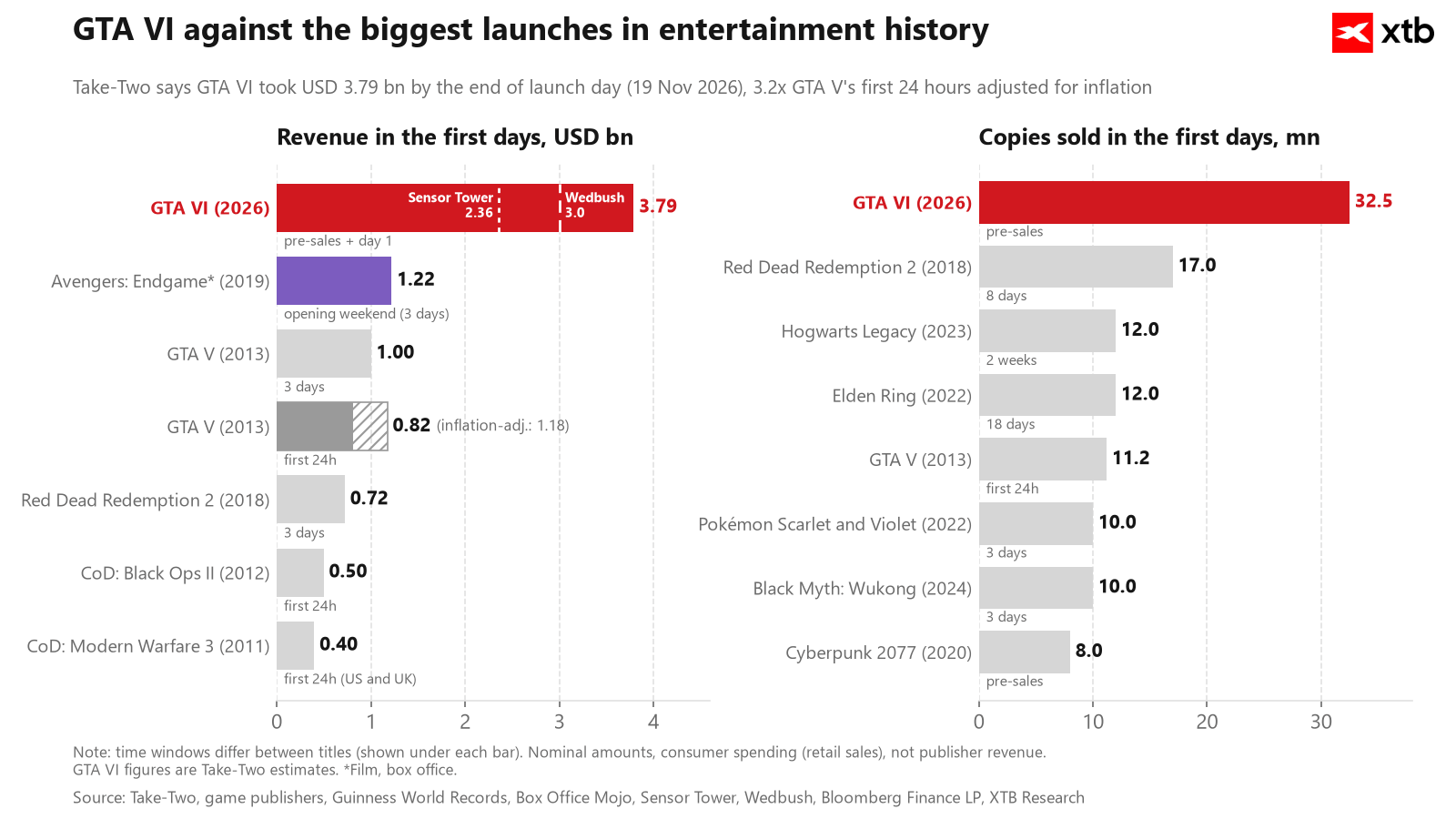
GTA VI Compared to the Biggest Releases in Entertainment History. Source: XTB For the capital market, however, it is crucial to take a sober look at the breakdown of these figures. The $3.79 billion figure represents gross spending by gamers (gross retail sales), from which platform owners (Sony, Microsoft) and retailers will take approximately 30% in commissions. Nevertheless, the scale of the impact makes the recent conservatism of Take-Two’s management, led by Strauss Zelnick, look today like classic sandbagging (deliberately lowering expectations). The company had previously forecast $3.35–3.50 billion in contract revenue (Net Bookings) for the entire holiday quarter and $8.0–8.2 billion for the full 2027 fiscal year. Meanwhile, the launch day alone has already accounted for 57% of the most optimistic scenario for gross spending over the first 12 months projected by Bloomberg analysts ($6.7 billion on 60 million copies sold). If holiday demand maintains its momentum, Take-Two’s full-year Net Bookings could reach as high as $8.7 billion —forcing Wall Street to sharply revise its models upward. An additional driver of margins remains the high share of the more expensive Ultimate Edition ($99.99), with the premium from which is booked directly into high-margin, recurring player spending (RCS).
Critics are ecstatic, the competition is “raking in the leaves,” and the players… are divided
The paradox surrounding the release of GTA VI lies in the unprecedented disconnect between industry reviews and the reaction of part of the community. On Metacritic, Rockstar’s game achieved an average score of 99/100 based on 152 critic reviews—with a 100% positive rating.

Screenshot showing Metacritic scores (99 vs. 5.7). Source: Metacritic The game’s technical and artistic sophistication caused a stir even among its biggest rivals. Igor Sarzyński, creative director of the Cyberpunk at CD Projekt RED, commented on the launch on social media with a mix of detachment and admiration, writing about the “depression among open-world game developers” and joking that he was canceling Cyberpunk 2 to go rake leaves in the backyard. Although he quickly clarified that the Polish studio is following its own unique path, his post perfectly captures the technological chasm that Rockstar has just created.

Igor Sarzyński’s post on Bluesky. Source: B luesky The right side of the Metacritic page, however, tells a completely different story. The average player score (based on nearly 120,000 votes) stands at just 5.7/10 , with extreme polarization: 50% of reviews are positive, as many as 43% are negative, and only 7% are mixed. “Tens” and “ones” dominate online. The main complaint? The lack of a 60 frames-per-second mode even on the PS5 Pro, and the slower, more realistic pace of gameplay. Should the stock market be concerned about this? In the short term—no. The industry’s history (from Cyberpunk 2077 to subsequent installments of Call of Duty or EA Sports FC) shows that the phenomenon known as review bombing rarely slows down sales of a mass-market hit that has become a global cultural phenomenon. The real test for TTWO’s long-term valuation, however, will not be online reviews, but player retention and monetization of the new GTA Online and the GTA+ subscription. It is there—and not in discussions about animation fluidity—that it will be determined whether GTA VI will repeat its predecessor’s decade of financial dominance. GTA VI proved right from the start that, commercially speaking, it’s in a league of its own, and Take-Two’s financial foundation received a massive cash injection. Now the ball is in the market’s court: the coming trading sessions will show whether the record $3.79 billion will be enough to permanently break through the technical barrier of $228, or whether Wall Street will decide that new highs will only come once we see the true monetization potential of the new GTA Online.
This content is for information only and does not constitute investment advice.